
1️⃣ Introduction
In the modern water sports market, wakeboards and wakesurf boards have become two dominant product categories that attract very different users. Both are designed to ride the wake behind a boat, yet their riding styles, construction, and performance characteristics are completely distinct. For buyers and surfboard brands, understanding these differences is essential to developing the right product range that satisfies diverse riders and market demands.
2️⃣ Riding Style and Tow Setup
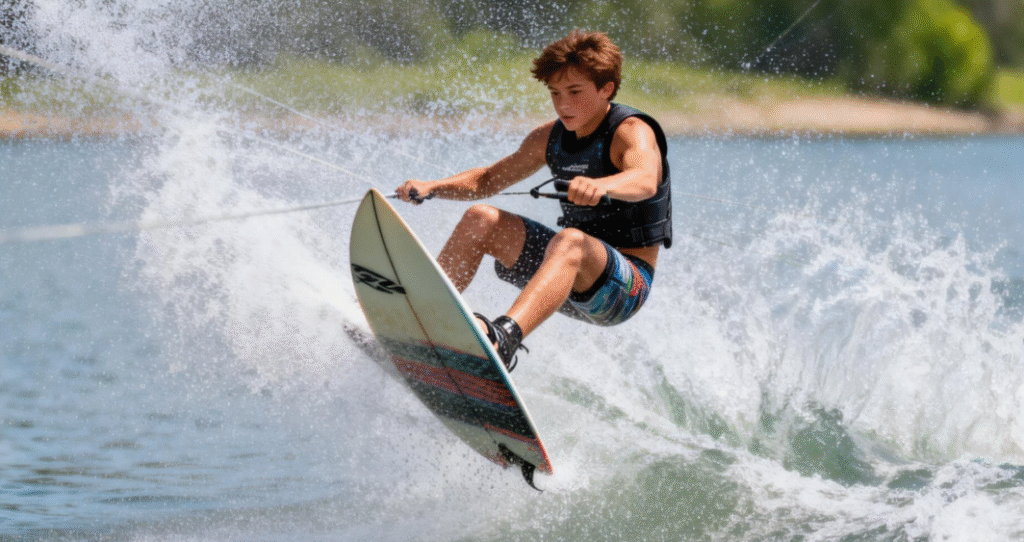
The most fundamental difference lies in how the rider interacts with the boat and the wave. Wakeboard riders are continuously towed by a rope attached to the boat, using the wake as a ramp to perform jumps and spins. Wakesurf riders, however, start with a rope but let go once stable, riding freely on the boat’s wave — similar to ocean surfing in a controlled lake environment.
3️⃣ Board Structure and Construction
Structurally, wakeboards and wakesurf boards are engineered for different loads and flex behavior. Wakeboards feature composite with eps cores laminated with fiberglass under pressure. The outer base uses durable grind-resistant materials like P-tex,tpu, to withstand impact. They are thinner, stiffer, and reinforced around binding inserts. Wakesurf boards typically use EPS foam cores with epoxy or soft deck construction, emphasizing buoyancy and flow for a smoother, surf-like glide.
4️⃣ Shape and Rocker Design
Wakeboard shapes are generally symmetrical (twin-tip) for bidirectional riding. The rocker profile (continuous or three-stage) affects pop and landings — continuous rockers provide smooth rides, while three-stage rockers deliver higher lift for tricks. Wakesurf boards have surfboard-like directional shapes with pointed noses and rounded tails. Their rocker lines are flatter through the midsection for speed and slightly curved at the nose for control.
5️⃣ Fins, Edges, and Traction
Wakeboards use shallow molded fins or detachable center fins combined with sharp edges for precision and grip. Their edges bite the water for jumps and landings. Wakesurf boards use larger surf-style fins — single, twin, or thruster setups — focused on carving and stability rather than pop. Their rails are softer for smoother transitions and forgiveness.
6️⃣ Volume and Buoyancy
Wakeboards are dense and negatively buoyant, sinking when not towed as they rely on rope tension for lift. Wakesurf boards are highly buoyant, allowing riders to float naturally and paddle if needed. This difference defines their target experience: wakeboarding emphasizes power and tricks, while wakesurfing prioritizes flow and feel.
7️⃣ Market Segmentation and User Profile
Wakeboards target younger, adrenaline-driven riders who seek trick-based excitement, common in cable parks and resorts. Wakesurf boards appeal to broader demographics, including families and lifestyle riders, valuing social experience and ease of learning. For OEM buyers, wakesurf boards often generate higher repeat orders due to wider appeal and faster learning curves.
8️⃣ Design Considerations
When developing wakeboards or wakesurf boards, key priorities differ. Wakeboards require precise rocker control, strong binding inserts, and tension-resistant cores. Wakesurf boards need lightweight EPS construction, consistent lamination, soft decks or slick bottoms, and integrated fin systems. Factories should balance production efficiency, materials, and durability according to the target market — schools, rentals, or premium retail.
9️⃣ Materials and Production Notes
Wakeboards demand impact-resistant materials and industrial-grade lamination. Wakesurf boards require fine finishing and design flexibility with colored EVA decks, printed slicks, or EVA pads. Both categories can be manufactured under one facility , but distinct curing and finishing processes.
�� Conclusion
Although wakeboards and wakesurf boards share the same wake, they represent two philosophies: power versus flow, control versus freedom. For OEM buyers, understanding these distinctions helps design targeted product lines that meet global demand. Whether developing a high-performance twin-tip wakeboard or a smooth epoxy wakesurf board, the right manufacturing approach ensures both performance and profitability.