
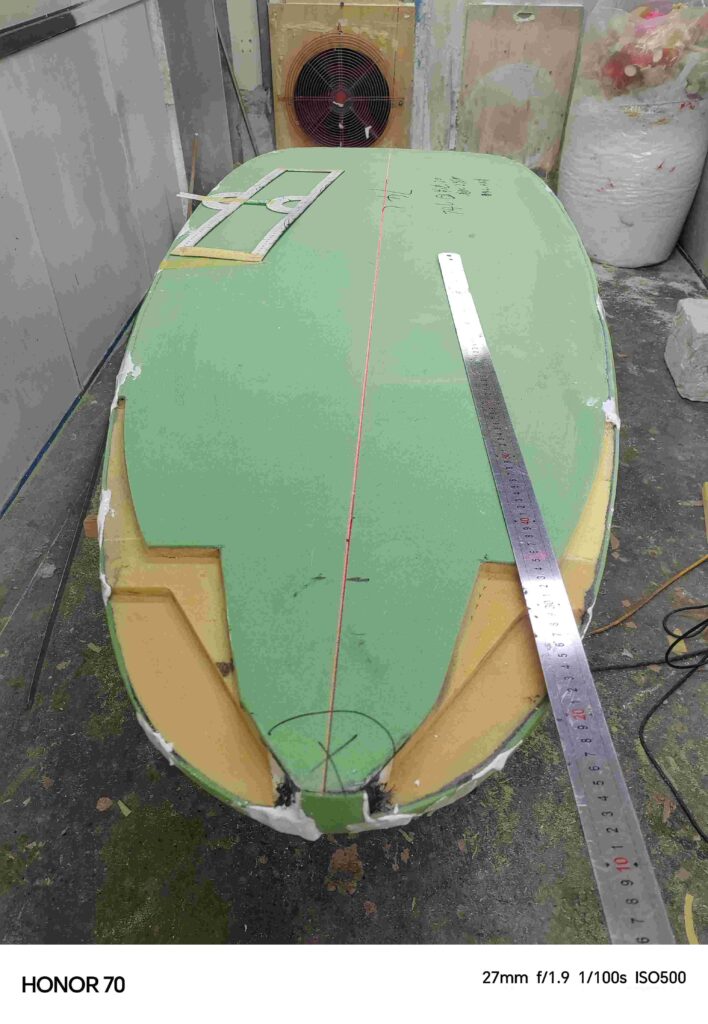
1️⃣ Introduction
The performance of a modern windsurf board is defined not only by its materials but also by its hydrodynamic shape — how the board interacts with water flow, drag, and lift. From the rocker line to the rail edges, every curve affects how efficiently the board planes, accelerates, and turns. Understanding these design principles is essential for brands, riders, and manufacturers seeking the perfect balance between speed, stability, and maneuverability.
2️⃣ The Role of Hydrodynamics in Windsurf Design
Hydrodynamics refers to how water moves around the board’s surface as it glides, planes, or carves. When a board planes correctly, it rises above the water’s surface, reducing drag and allowing faster speeds with less effort. Key design parameters — rocker line, outline, volume distribution, bottom contour, and rails — all interact to determine how easily this happens.
In the past, designs focused on maximizing volume for stability. Today, with lighter materials like carbon composites and refined shaping technology (CNC precision shaping, vacuum lamination), shapers can design thinner, faster boards that maintain strength without compromising control.
3️⃣ Rocker Line: The Foundation of Speed
The rocker line — the longitudinal curve from nose to tail — is the single most influential hydrodynamic factor.
– Flat Rocker: A flatter rocker increases waterline length and minimizes drag, resulting in higher top-end speed. It’s common in slalom and racing boards where straight-line velocity is key.
– Curved Rocker: More curvature improves maneuverability, especially in wave or freeride boards, where smooth turning and control in chop are priorities.
Modern freerace boards often use a progressive rocker: flat midsection for speed and slightly lifted nose for forgiving control in gusty or choppy water. This “dual-behavior” rocker allows both acceleration and comfort — a hallmark of modern design.
4️⃣ Outline and Width Distribution
The outline — viewed from above — dictates how water flows along the rails and how the board maintains balance.
– Wide Midsection: Provides early planing ability and stability, perfect for lighter winds and entry-level use.
– Narrow Tail: Reduces drag and improves release at high speeds, often paired with sharper rails for clean water exit.
– Compact Shapes: Seen in foil boards and new-generation freeride boards, shorter outlines combined with optimized width distribution improve lift and reduce swing weight.
Shapers increasingly use computer-aided modeling to test outline variations digitally before final mold creation, allowing precise performance tuning.
5️⃣ Bottom Contours: Managing Lift and Drag
The bottom contour defines how water channels beneath the board, affecting lift, drag, and turning response.
– Single Concave: Creates consistent water flow and increases lift under the midsection — common in speed and slalom boards.
– Double Concave / Vee Entry: Smooths transitions between rails, improving stability in chop and aiding easier rail-to-rail turning.
– Flat Bottom: Provides clean water release and predictable planing for beginners or rental boards.
Many high-performance boards now feature multi-stage concaves — combining single concave at the nose (for lift) and Vee tail exit (for smooth release). This configuration provides both acceleration and control across variable wind conditions.
6️⃣ Rail Design: The Key to Control
Rails are where water leaves the board. Their geometry determines grip, release, and handling under pressure.
– Hard Rails (Tail Section): Sharper edges allow faster water release and higher top speed — essential for slalom and foil boards.
– Soft or Rounded Rails (Nose and Midsection): Help maintain control in turns and absorb impacts in choppy conditions.
Modern windsurf boards often blend both — soft entry rails for comfort transitioning into hard tail edges for acceleration. The combination ensures responsive yet stable performance across all riding styles.
7️⃣ Volume and Balance Distribution
Volume defines buoyancy, but where that volume is placed defines handling.
– Boards with forward volume concentration provide lift for early planing.
– Boards with balanced mid-volume offer consistent control during gybes and turns.
– Compact boards with rear-biased volume pair perfectly with foils, positioning lift near the mast track for efficient takeoff.
With advanced shaping and epoxy-carbon layups, designers can fine-tune internal structure without adding unnecessary thickness — keeping the board light and reactive.
8️⃣ Tail and Fin Interaction
The tail shape and fin box position directly affect how the board channels power from the sail.
– Square or Wide Tail: Offers more lift and easier planing, used in freerace and foil boards.
– Pin Tail: Reduces drag, offering better control at high speeds.
A correctly aligned fin box ensures that hydrodynamic flow matches the rocker angle — maximizing thrust and directional stability. In foil boards, the foil mount position replaces this dynamic: precise angle alignment ensures lift balance between mast and tail rocker for smooth, controlled flight.
9️⃣ Manufacturing Precision and Hydrodynamic Consistency
The best hydrodynamic design means little without precision production. Modern manufacturers now use CNC shaping machines and multi-axis molds to maintain rocker accuracy within millimeter tolerance. This ensures that every board in a production series performs identically — crucial for global brands that demand consistent hydrodynamic behavior from one model to another.
Vacuum infusion and pre-preg lamination further stabilize the board’s shape under curing pressure, preventing deformation and ensuring long-term hydrodynamic stability.
�� Conclusion
Hydrodynamics sits at the heart of windsurf board innovation. Every contour, curve, and line defines how water interacts with the board — and ultimately, how fast, stable, and responsive it feels.
Through advanced materials and precision shaping, today’s windsurf boards achieve a harmony that was once impossible: lightweight speed, predictable control, and effortless planing. As engineering and craftsmanship continue to merge, the modern windsurf board isn’t just built — it’s sculpted to move perfectly with water.