
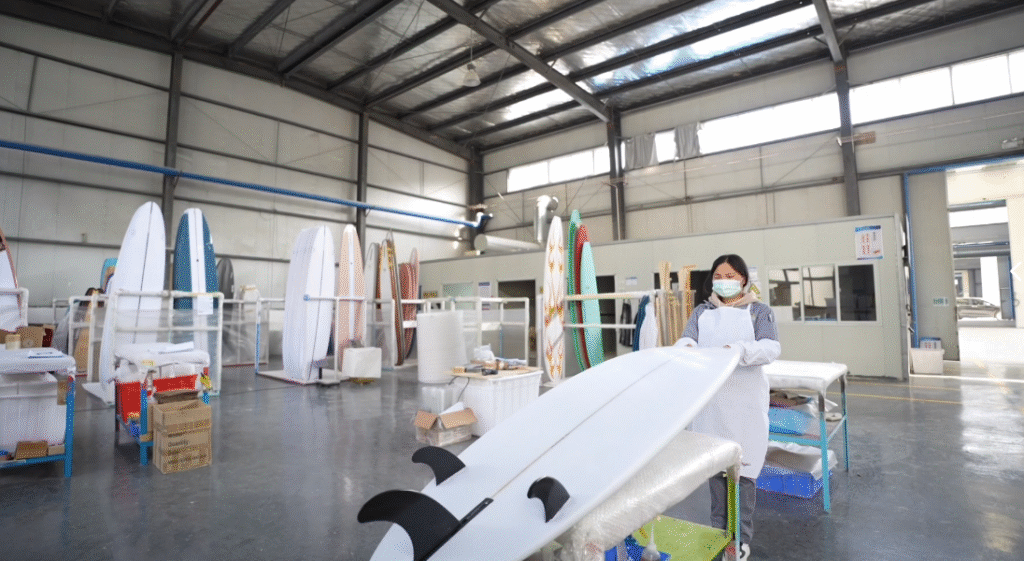
A surfboard can look perfect in a sample room and still become a problem once production starts.
This happens more often than many brands expect. A shape changes slightly between batches. A material behaves differently at production scale. A delivery date moves because a component wasn’t confirmed early enough. Or a board that looked great in a prototype simply costs too much to produce at the target price.
Most manufacturing problems don’t start on the production line. They start much earlier, when a brand and its factory make assumptions that were never properly discussed.
Here are some of the mistakes we see most often.
Treating the Factory as the Last Step
One of the easiest mistakes is bringing the manufacturer into the process too late.
A brand may have already finalized the shape, graphics, materials and target price before asking the factory to produce it. By that point, changing the construction can be expensive or even impossible.
A good manufacturing partner should be involved before the design is locked. Some ideas that look straightforward on paper can create problems during production, while a small change in materials or construction may make the product easier to manufacture without changing what the customer sees.
The earlier those conversations happen, the fewer surprises there are later.
Choosing a Factory Mainly on Price
The lowest quotation can be attractive, especially when margins are under pressure.
But the factory offering the lowest unit price isn’t necessarily offering the lowest total cost.
If production requires repeated corrections, quality problems lead to replacements, or delivery delays cause a missed selling season, the original saving can disappear very quickly.
For brands that plan to reorder the same model, consistency and reliability are usually worth more than saving a small amount on the first order.
Assuming a Good Sample Guarantees Good Production
A sample proves that something can be made.
It doesn’t automatically prove that it can be made consistently hundreds or thousands of times.
Mass production introduces variables that aren’t always obvious during sampling. Materials can vary between batches, workers may interpret specifications differently, and small differences in lamination, sanding, painting or assembly can affect the final product.
This is why production standards need to be defined before the first large order—not after problems appear.
Changing Specifications Too Often
Product development naturally involves changes. The problem starts when specifications continue changing after production has already been prepared.
A last-minute graphic change may affect printing. A different deck material can change the production process. A small adjustment to a shape may require a new mold or affect other components.
None of these changes is necessarily difficult on its own. The real issue is that several small changes can quickly disrupt production planning.
A clear specification sheet and a defined approval process can prevent many of these problems.
Underestimating the Importance of Materials
Materials aren’t simply interchangeable line items on a quotation.
Different foam densities, fiberglass weights, resins, deck materials, reinforcement fabrics and adhesives can change the weight, flex, durability and production cost of a board.
A construction that works well for one product may not be the right choice for another.
Brands don’t need to become material specialists themselves. But they do need a manufacturing partner who can explain what a material change will actually do to the finished product.
Focusing on the First Order Instead of the Reorder
A first production run can sometimes be managed with extra attention from everyone involved.
The real test comes later.
If the brand reorders six months later, can the factory reproduce the same construction, dimensions, colors and finish? Can the same materials still be sourced? Are the production specifications clear enough that another team can follow them?
A product designed for repeat production is much more valuable than one that can only be produced successfully once.
Leaving Quality Standards Too Open to Interpretation
Words such as “good quality,” “premium finish,” or “same as the sample” sound clear until two people interpret them differently.
A stronger production process uses measurable standards wherever possible.
That might include dimensions, weight ranges, material specifications, color references, acceptable tolerances, surface requirements and approved samples.
The more important a detail is to the final product, the less it should depend on interpretation.
Ignoring the Production Lead Time
Another common mistake is calculating lead time from the day the purchase order is placed.
In reality, production may not be able to start until artwork, materials, molds, components and specifications have all been approved.
For a new product, sampling and testing also need to be considered.
Brands that plan backward from their required delivery date tend to have much fewer problems than those simply asking, “How quickly can you make it?”
Trying to Solve Every Problem by Cutting Cost
When margins become tight, reducing manufacturing cost is an obvious place to look.
But not every cost reduction is a good one.
Changing a material, removing reinforcement or simplifying a construction may reduce the factory price while also changing the product’s durability or riding characteristics.
The better question is not always “How can we make this cheaper?”
Sometimes it is:
“Where can we reduce cost without reducing the value of the product?”
That requires a factory with enough experience to understand the difference.
Final Thoughts
Manufacturing problems are rarely caused by one dramatic mistake. More often, they come from a series of small assumptions made during development, sourcing and production.
Choosing a factory based only on price, involving the manufacturer too late, changing specifications at the last minute, or failing to define quality standards can all create unnecessary risk.
The strongest brand–factory relationships tend to work differently. Both sides communicate early, understand the product requirements, solve production issues before mass manufacturing begins, and build specifications that can be repeated from one order to the next.
For a surf brand, the goal isn’t simply to manufacture one good board.
It’s to build a product that can be produced consistently, at the right cost, and at the right quality—every time the order is repeated.