
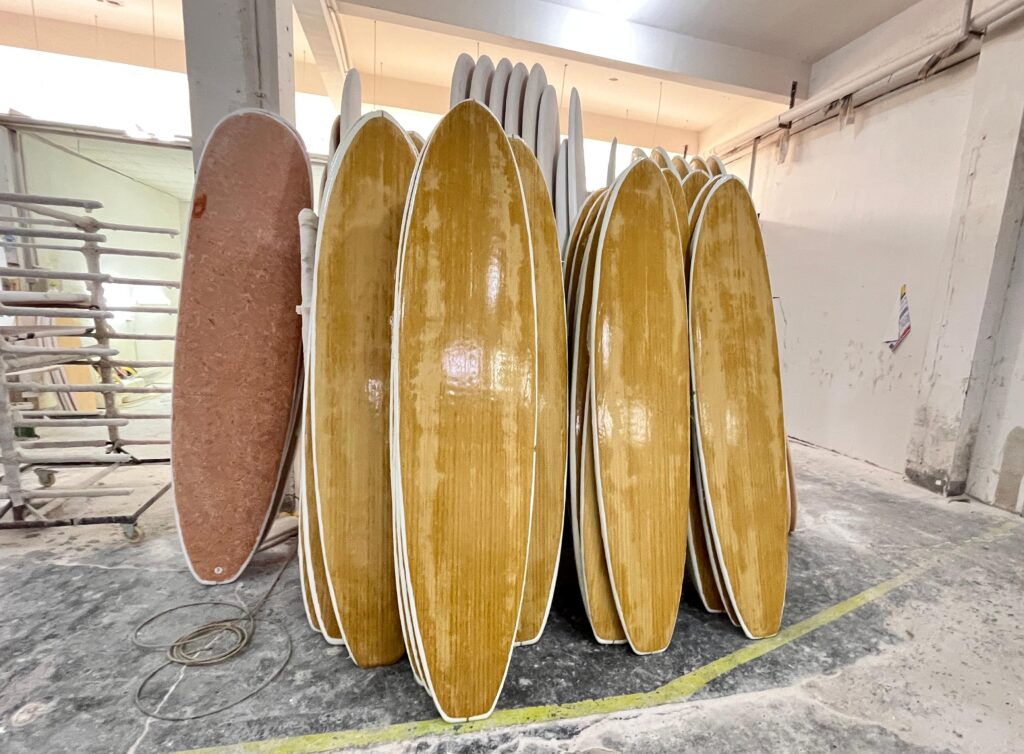
We often hear the same question from surf brands: How do you know if a surfboard factory is reliable?
It’s a fair question. Most factories can make a good sample. Most can offer a competitive price. And almost every factory will tell you that quality and delivery are important.
But after years of producing surfboards and other watersports boards for brands, we’ve learned that reliability has very little to do with what a factory promises at the beginning.
It is what happens after the first order.
A Good Sample Is Only the Starting Point
When we develop a new board, getting the first sample right is important. But we don’t consider the job finished when the sample looks good.
The bigger question is whether we can make the same board again—and again—with the same construction, dimensions, weight and finish.
This is where manufacturing experience starts to matter.
During mass production, small differences can appear in materials, lamination, shaping, painting or finishing. Our job is to control those variables before they become problems for the customer.
For us, consistency is more important than making one impressive sample.
We Pay Close Attention to Materials
Surfboard manufacturing depends heavily on materials.
Foam density, fiberglass, resin, reinforcement materials, deck materials, adhesives and finishing materials can all change the final result. Even when two materials look similar, they may behave very differently during production.
We therefore don’t treat materials simply as items on a purchasing list.
When a construction is approved, the materials and specifications need to be clear. When materials arrive, they need to be checked. And when a product is reordered months later, we need to know what was used previously.
This is particularly important for brands that want the same model in their range for several seasons.
We Build Processes, Not Just Products
One thing we’ve learned over the years is that a factory cannot rely on one skilled person to make everything perfect.
People are important, but the production process needs to be stronger than any individual.
For each product, we need clear specifications and repeatable manufacturing procedures. The production team needs to understand what matters most on that particular board, from construction and reinforcement to finishing details.
That makes the result much more stable when production volume increases.
Quality Control Starts Before the Final Inspection
We don’t believe quality control should happen only when a finished board reaches the inspection table.
By then, it’s often too late.
We prefer to identify problems earlier—when materials are received, during key production steps, and throughout the manufacturing process.
If something is wrong with a component or construction, finding it early can prevent the same problem from appearing across an entire production run.
Final inspection is still necessary, but good quality control starts much earlier.
Clear Communication Saves a Lot of Problems
Some of the most expensive manufacturing problems we’ve seen weren’t caused by complicated technology.
They came from unclear information.
A small change in artwork. A different material requested during development. A dimension that was interpreted differently. A production detail discussed in an email but never added to the final specification.
We have learned to put as much important information as possible into clear specifications, drawings, approved samples and production instructions.
The more important a detail is, the less we want it to depend on someone’s memory.
We Don’t Just Look at Whether a Design Can Be Made
When a brand brings us a new concept, our job isn’t simply to say yes or no.
We look at how the design will work in actual production.
Sometimes a construction needs to be adjusted. Sometimes a material can be changed without affecting the customer’s experience. Sometimes a small modification can make a product stronger, easier to manufacture, or more cost-effective.
We don’t want to change a brand’s idea unnecessarily. But we do believe a good manufacturing partner should be able to point out potential problems before they become production problems.
Predictable Lead Time Is More Valuable Than a Fast Promise
We’ve seen how difficult production planning can become when a factory promises a lead time that is simply too optimistic.
For a brand, a realistic delivery date is much more useful than an impressive promise that later changes.
Our production planning has to consider materials, molds, capacity, sampling, artwork approvals and existing orders.
We would rather give a realistic lead time at the beginning than create a problem for a customer later.
Capacity Should Not Destroy Quality
Growing brands eventually face a different problem.
Their product starts selling well, and suddenly the production volume needs to increase.
This is where a factory’s real manufacturing capability becomes important.
Increasing output isn’t simply about putting more workers on the production line. Materials, processes, equipment, quality control and production management all need to scale together.
Our goal is not just to produce more boards. It is to maintain the same product standards when production increases.
The Real Test Is the Next Order
For us, one of the best indicators of a good manufacturing relationship is what happens when the customer places the second or third order.
The factory should already understand the product.
The approved construction, materials, artwork, specifications and quality requirements should be documented and available. The team should not need to start from zero every time the same model is ordered.
A repeat order should be smoother than the first order.
That’s what good manufacturing systems are supposed to achieve.
So, What Makes a Factory Reliable?
After years in this industry, we don’t think reliability comes from one particular machine, one impressive factory building, or one low quotation.
It comes from doing many basic things correctly, every day.
Controlling materials.
Keeping production consistent.
Checking quality throughout the process.
Communicating clearly.
Giving realistic lead times.
Solving problems before they reach the customer.
And most importantly, remembering that the board being produced today may still be part of a brand’s product range several years from now.
For us, that’s the real meaning of being a reliable surfboard factory.
We don’t just want to make a board that passes inspection today. We want to build a manufacturing system that allows our customers to order the same product with confidence again and again.