
1️⃣ Introduction
Every surfer’s journey starts with the right board. For beginners, a surfboard isn’t just equipment — it’s a teacher. The right design helps new riders find balance, stability, and confidence in the water. For buyers and surf brands, understanding what defines a good beginner surfboard is key to creating models that perform well, last long, and attract loyal customers.
2️⃣ Key Qualities of a Beginner Surfboard
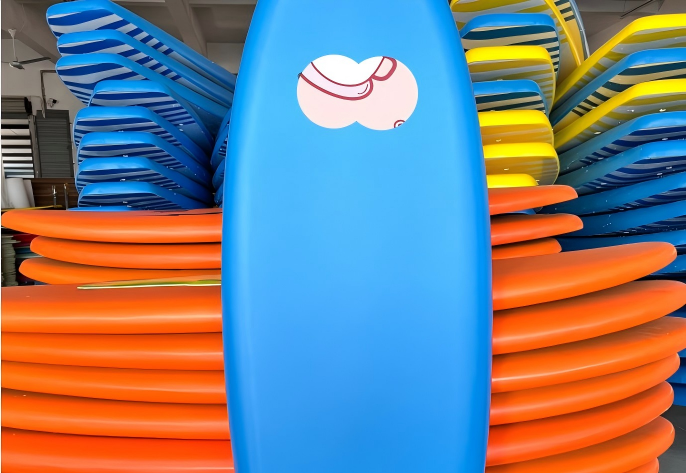
A beginner surfboard must be forgiving, stable, and easy to paddle. The focus is not on high performance but on building fundamental skills. Essential qualities include high buoyancy, wide outline, soft surfaces with round rails, and durable materials that withstand repeated use.
3️⃣ Ideal Materials for Beginner Surfboards
Material choice determines weight, safety, and durability. The most common constructions include: Softboards (IXPE or PE deck + EPS core) — offering buoyancy, comfort, and safety, perfect for surf schools and rentals. Epoxy Softboards — a hybrid design combining EPS cores with epoxy resin and soft outer layers, ideal for progressing beginners. Traditional Epoxy Boards — lightweight and responsive but less forgiving, better suited for those advancing from beginner level.
4️⃣ Size: Length, Width, and Thickness
Size plays the most critical role in beginner success. Lengths between 7’0–9’0 offer easy paddling and early wave-catching. Widths from 21”–23” add stability, while thicknesses around 2.75”–3.5” ensure buoyancy. The general rule: the taller and heavier the surfer, the larger the board required.
5️⃣ Shape: Outline and Rocker
Beginner surfboards prioritize stability over performance. Wide noses and round tails add balance and lift. Flatter rockers through the midsection help speed and paddling efficiency, while slightly lifted noses prevent pearling. Soft, round rails enhance stability and safety.
6️⃣ Volume and Weight Ratio
Beginners benefit from higher volume boards for float and forgiveness. A practical guideline: Volume (L) ≈ Rider’s Weight (kg) × 1.5. For instance, a 70 kg beginner should start with a board around 100 L. EPS foam cores help achieve this without excess weight.
7️⃣ Safety and Durability
A good beginner board must resist impact, UV exposure, and rough handling. IXPE decks with slick HDPE bottoms provide ideal shock absorption and flexibility. Reinforced nose and tail bumpers help prevent deformation, essential for surf schools and rentals.
8️⃣ OEM Manufacturing Considerations
For manufacturers, beginner surfboards represent high-volume opportunities. Key considerations include standardized molds for consistency, material optimization between cost and performance, customizable branding options, and thorough durability testing under heat and pressure conditions.
9️⃣ Matching Products to Market Segments
Different market segments require tailored designs: Surf schools prefer 7’0–9’0 softboards with IXPE decks and slick bottoms. Retail beginners often seek 7’0–8’0 epoxy softboards 7. Advancing learners may prefer 6’6–7’2 epoxy hardboards with sharper rails for added control.
�� Conclusion
A great beginner surfboard balances stability, safety, and comfort. Whether designed as softboards or epoxy soft models, these boards serve as the entry point into surfing culture. For buyers, success lies in combining smart material use, ergonomic design, and brand appeal to create products that help riders stand, smile, and surf again.