
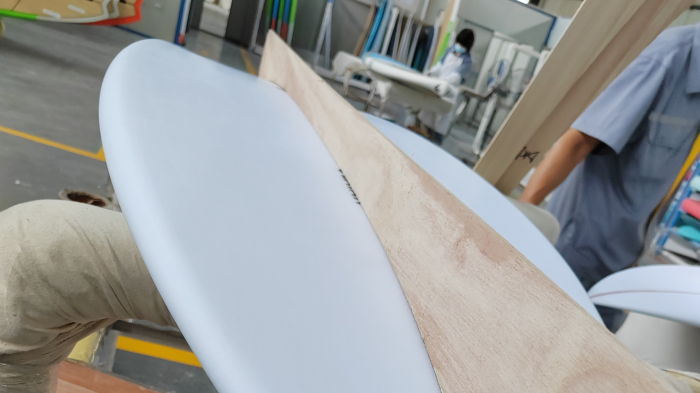
1️⃣ Introduction: Why Rocker Dictates 70% of How a Surfboard Feels
As a manufacturer shaping tens of thousands surfboards every year for global brands, I can say this with confidence: the rocker profile is one of the most defining elements of a board’s performance.
Nose, mid, and tail rocker influence paddling efficiency, speed, wave entry, turning radius, pocket control, and overall handling. Understanding these three zones is the foundation of effective surfboard design.
2️⃣ Nose Rocker: Control, Safety, and Vertical Performance
The nose rocker determines how the board behaves in steep waves and critical sections.
More nose rocker provides:
– Better steep-wave entry
– Reduced pearling (nosediving)
– More vertical performance
– Improved control in hollow waves
Less nose rocker offers:
– Faster paddling
– Earlier wave entry
– Better glide in softer waves
– More stability for beginners
As a manufacturer, I match nose rocker to the target market: low for beginners, moderate for hybrids, and higher for high-performance shortboards.
3️⃣ Mid Rocker (Center Rocker): The Engine Behind Speed and Glide
The mid rocker controls the board’s speed, flow, and forward drive.
Flatter mid rocker creates:
– More speed
– Better small-wave performance
– Stronger drive
– Easier paddling
More curved mid rocker creates:
– Tighter turning radius
– Faster rail-to-rail transitions
– Better performance in powerful waves
This zone is often the one we fine-tune most when brands want to update a model.
4️⃣ Tail Rocker: Turning, Release, and Pocket Control
The tail rocker dictates how the board pivots and releases water.
More tail rocker provides:
– Tighter turns
– Cleaner release off the lip
– Strong pocket control
Flatter tail rocker offers:
– More down-the-line speed
– Better projection
– Easier trimming
This is why performance boards have more tail lift, while funboards and small-wave boards stay flatter.
5️⃣ How Rocker Combinations Shape Different Board Types
Different surfboard categories use different rocker formulas:
**Performance Shortboards** – High nose, moderate mid, high tail
**All-Round Hybrids** – Moderate nose, flatter mid, light tail lift
**Grovelers** – Low nose, flat mid, minimal tail rocker
**Softboards / Epoxy Softboards** – Low nose, flat mid, slight tail lift
**Longboards** – Moderate nose, flat center, light tail rocker
More rocker = more control. Less rocker = more speed.
6️⃣ Why Rocker Precision in Manufacturing Matters
Rocker is extremely sensitive during production.
As a large OEM, we must control:
– CNC cutting accuracy
– Lamination pressure
– Stringer tension and curing
– Symmetry across the centerline
Even small deviations can change how a board paddles, trims, or turns.
7️⃣ How Brands Should Choose the Right Rocker
When helping brands design or update models, I focus on three questions:
1) Who is the target rider?
2) What waves is the board for?
3) What feeling should the board deliver?
The rocker profile is the foundation of all these decisions.
8️⃣ Conclusion: Rocker Is the Heart of Surfboard Design
From my experience manufacturing boards across all categories, rocker remains the single most important design element.
Nose rocker controls safety and steep-wave entry.
Mid rocker defines speed and flow.
Tail rocker decides turning and release.
Accurate rocker = consistent performance.
A surfboard’s personality comes from its curve—and understanding rocker is the key to building better boards for global markets.