
Introduction
Stringers are the internal spine of a softboard. They control flex, add strength, and stabilize the board through shipping, rental abuse, and repeated sessions. For OEM buyers, getting the stringer specification right is the difference between a commodity foam-top and a premium, long-lasting softboard that riders actually come back for.
1️⃣ What Is a Stringer?
A stringer is a strip of reinforcing material—most commonly wood—placed inside the foam core of a board. It provides structural integrity, prevents unwanted twisting, and determines how much the board flexes under load. While softboards often prioritize safety and value, the incorporation of a wood stringer elevates them closer to performance models.
2️⃣ Why Use Wood Stringers?
Wood has a natural combination of stiffness, elasticity, and vibration damping—a balance few synthetic materials can match. It makes the board feel lively but controlled, giving riders smoother turns and better energy feedback.
Key Benefits of Wood Stringers:
• Structural Strength — reinforces EPS or pu cores against breaking.
• Flex Control — helps maintain consistent rebound during turns.
• Shape Stability — reduces warping under high temperature or stress.
• Customizable — multiple stringers or different placements can fine-tune flex for target riders.
3️⃣ Common Stringer Configurations
Different boards use different configurations depending on their size, material, and use case:
| Configuration | Description | Best For |
| Single Stringer | One central wood strip | Standard softboards, balanced flex |
| Double Stringer | Two parallel strips near rails | Wider boards needing extra rigidity |
| Triple Stringer | Central + two side reinforcements | Large or heavy-duty school boards |
| No Stringer (HD Core) | Relying on high-density EPS | Lightweight or advanced riders |
4️⃣ Material and Design Variations / Wood Choice in Modern Softboards
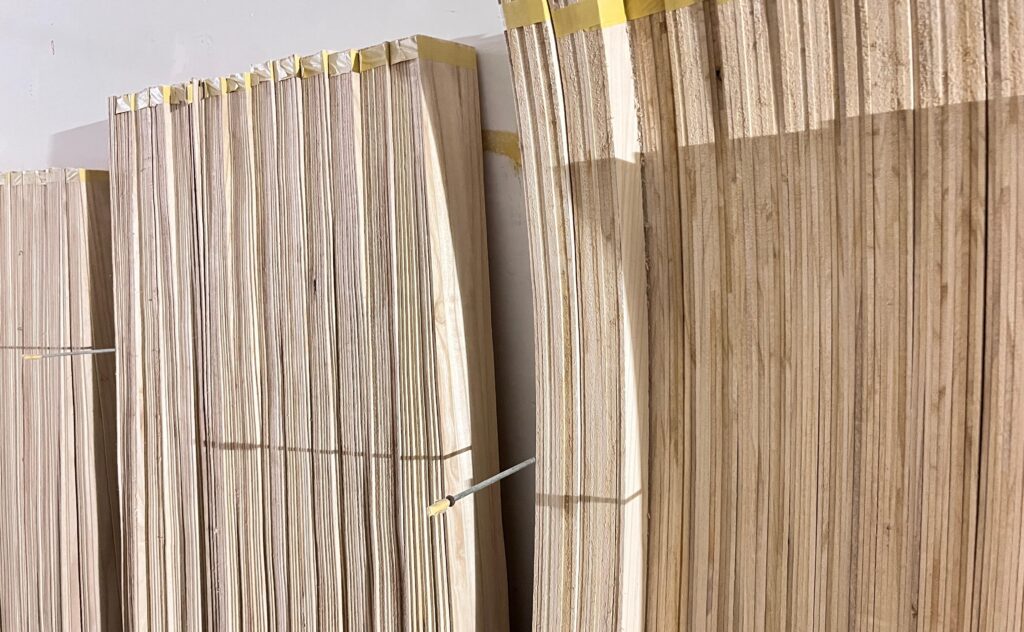
Modern softboards primarily use paulownia wood stringers — a lightweight, strong, and stable species that has become the industry standard for reinforcement. Older materials such as basswood and birch were widely used in earlier generations of boards but have largely been replaced due to their heavier density and higher moisture sensitivity.
Advantages of Paulownia Wood:
• High strength-to-weight ratio — provides excellent stiffness without adding unnecessary weight.
• Dimensional stability — resists warping under temperature or humidity changes.
• Good bonding performance — adheres reliably to EPS and pu cores in large-scale OEM production.
• Workability — easy to machine and shape precisely for consistent flex control.
• Eco-friendly option — fast-growing and sustainably sourced, supporting green manufacturing initiatives.
Some factories may also use bamboo veneers to tune flex or enhance the aesthetic finish, but paulownia remains the primary and most efficient choice for softboard stringers today.
5️⃣ OEM Design Insights
For OEM buyers, stringers provide a chance to customize ride feel and optimize durability for different markets. Consider rider level, core material, production efficiency, and cost-to-value ratio when specifying your stringer configuration.
Conclusion
Wood stringers transform how a softboard performs—turning flexible foam into a controlled, durable, and responsive ride. For OEM partners, mastering stringer configuration and material selection is the key to building softboards that not only look good but perform exceptionally across markets.
�� Contact us to customize your OEM softboard designs — available with single, double, or triple wood stringer options.